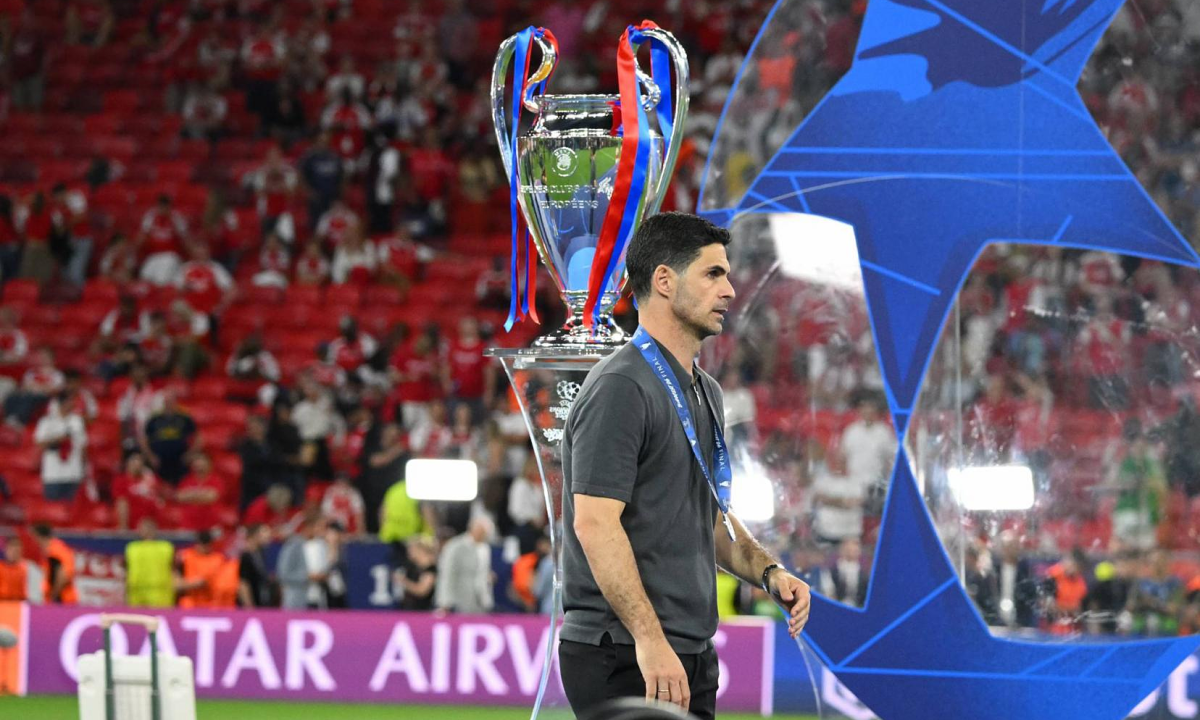
The most classic lie about the indoctrination series is to treat them as a chance lottery. The penalty rock is a skill of identification and exercise. It's not just a test of the ability to kick the ball or choose the angle, it's also a game of analysis data, psychological blow and steel percussion under a thousand-pound pressure.
When Eberechi Eze throws the ball out, or Gabriel Magalhaes takes the ball straight towards the Danube River (Budapest, Hungary), which is the worst way to fail. But anyway, it's still a Arsenal defeat.
In the meantime, the second classic lie about the obligation or punishments is the prejudice that fortune has no role. Any match that is determined by 10 protagonists will certainly be subject to the unfairness of the elements of chance. It could be a congealed courtyard, an error relay, or a touch of chance from the goalkeeper's guess - for no matter how well prepared, catching penalty still has a guess.
The fact that football, a game that has been "lost" of the winning table, the fragile and numerous variables, has chosen to determine the highest titles by such small details, is one of its most ruthless qualities.
So, is Arsenal really less fortunate in Budapest? When dismissing righteous indignation, the assumptions if - is endless, or petty disputes over the decisions of the referee, Arsenal may have received of the outcome worthy of them.
The loss on the diocese dot after causing the DUMB to sweat and be confused for 120 minutes is clearly a painful end. But in the opposite direction, it's hard to deny a fact that from strategy, the plan to approach the game to the ideology, Arsenal largely pushed himself into this situation.
In essence and in the face of the best rivals, Mikel Artata's football philosophy was designed to limit the actual scenarios as much as possible, to then wait for the match to be determined by the few gaps left to the opponent. But a strategy is adapted just to find and defend the advantage leading to 1-0, with four platoons and a back-up formation, which will become or lose mainly by that harsh measure. The football of the "fragility" will always be stable, until it is struck by the smallest detail.
Does Arsenal have a more viable approach? Maybe not. Bayern Munich at the semi-finals exposed the limits when choosing to play a fair double with PSG according to their specialty. And Arsenal didn't own the Michael Oise, Harry Kane, Luis Diaz, or a philosophy based on storm-attack waves, rush, no mercy. They also lost two rear guards to excellence, and ended the match with the tributary on the line of Gabriel Martinelli, Noni Maddike and Viktor Gyokeres. This detail needs at least to be put in context to acknowledge the fairness of what one might expect in Arteta in the final.
The recent Arsenal transfers have always preferred the reinforcement of the ranks, increasing the depth and raising the overall level of the team, rather than bringing back the stars of the "X element". "will be able to decide a big bridge by a moment of genius.
It also appears to be an underground message in the self-portrait words of the Battle of Arteta, when he speaks of the need to "make improvements" and "find different borders". The Spanish military authorities praised the lyrics of the stars that Luis Ahmad had in his hand, speaking of how PSG chokes the space at will and forces the opponent to play in the areas they most hate on the field.
There is a assumption that after finally mending the British Exotic Thirsty, with a team entering the ninth age of the career, and having just forced the team to be considered the strongest in the world to squeeze to the last drop of sweat, Arsenal would surely soon take the final leap. That this was only the beginning of the golden era of Artata. All of that can be real. But what if that does not happen? What if this was the highest peak Arsenal could reach?
Because, there is a paradox. On the one hand, there is the idea that Arsenal thanks to good training, good culture, and standard procedure, that has worn out the last drop of energy from available resources, which allows them to compete in equal competition with the supermen and the machines that are backed up by the state of the continent. But on the other hand, there's the idea that this is a team that still has the potential to progress in the years to come.
Could both be at the right time? If Arteta has worn out every last drop of potential from this formation, what are the odds they find higher levels? What if this club was already operating at 105% of their capacity?
The desire for innovation and reaching out is enormous. The rookies will certainly help narrow the gap, but the warning story from Liverpool last summer is a reminder that the process is rarely smooth or without risk. World-class players call for an upgrade wage structure, new pieces of strategy, and a slightly different dressing room atmosphere. A club as well operated as Arsenal may be confident that they will buy more success than failure. But the bigger the gamble, the higher the risk.