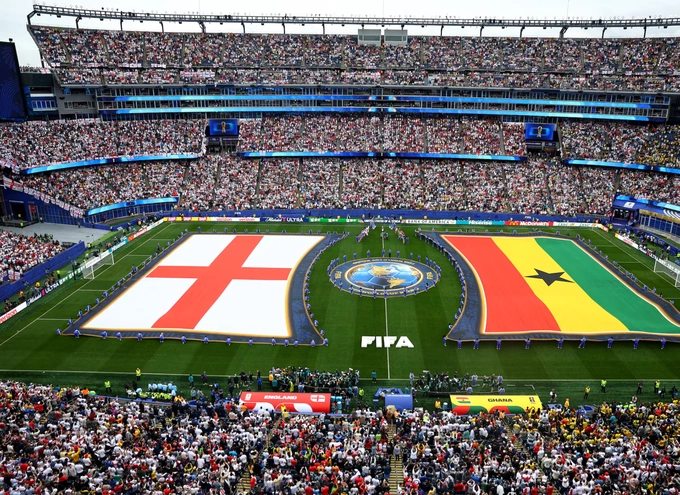
England and Ghana teams walk onto the pitch in Boston, Massachusetts, USA before their 2026 World Cup group stage match on April 23, 2026. Photo: Reuters
The 2026 World Cup not only expands to 48 teams, but also sees the return of the third-placed team standings for the first time since 1994. The 48-team format cannot be easily divided into 32. Teams advancing from the group stage will include 12 group winners, 12 runners-up, and the 8 best third-placed teams.
At the same time, this is the first World Cup in history to use head-to-head record instead of goal difference as the primary tiebreaker when teams are level on points. The head-to-head rule means teams can secure the top spot or be officially eliminated after just two matches. Currently, eight teams are playing dead rubbers in the final group stage round.
For example, in Group J, Argentina has secured 6 points and is guaranteed to finish top after defeating both Austria and Algeria, who have three points each. Conversely, Jordan, with 0 points, is officially eliminated after losing to both opponents.
If goal difference were still the top priority, every team would still have something to play for. But now, teams that have already achieved their group stage goals might field reserve lineups in the final match.
Furthermore, regarding the third-placed teams, with 12 groups, the organizers need five days to complete the final round of matches. This means teams playing early will have no idea how many points they need to secure a spot among the best third-placed teams. In other words, these will be "battles in the dark" for them. Conversely, teams playing later will know exactly what they need to do.
Take Scotland as an example. Steve Clarke's side sits third in Group C and is preparing to face Brazil in Miami (USA). Morocco and Haiti, the other two teams in the group, will face each other in Atlanta (USA) at the same time. Under normal circumstances, this schedule would ensure fairness. But Scotland is not just competing against Brazil, Morocco, or Haiti. They are competing against nearly 40 other teams—opponents who theoretically could still finish third at this point.

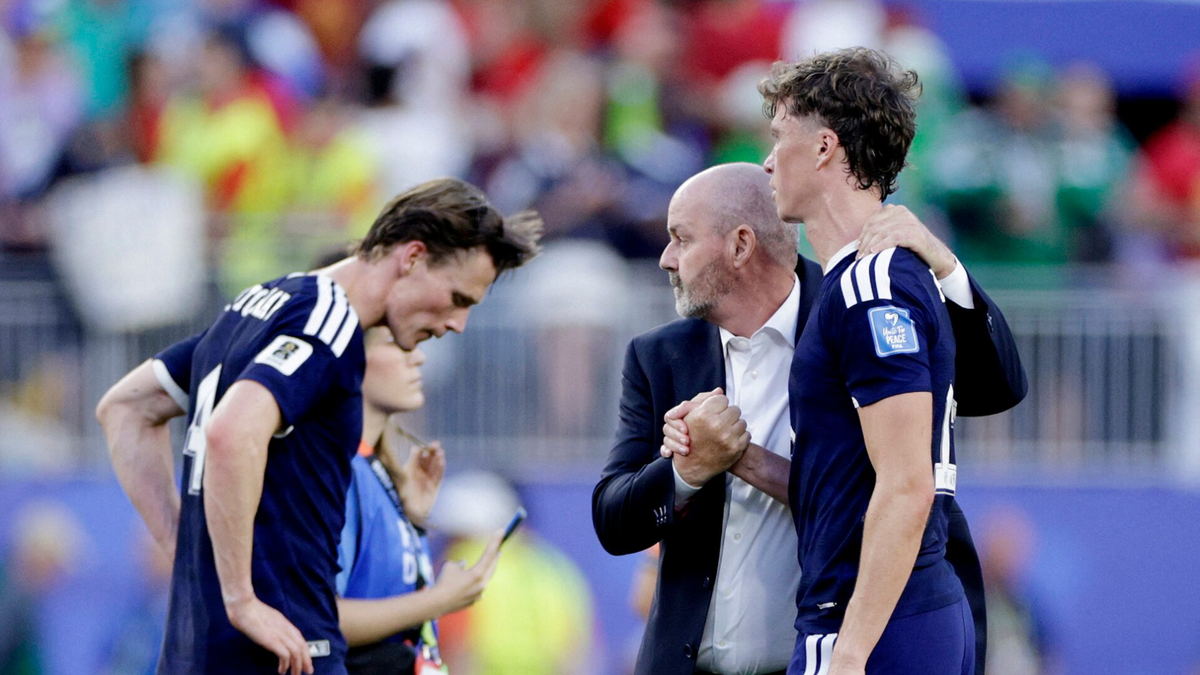
Coach Steve Clarke (right) and his players during a water break in the Scotland vs. Morocco match in the 2026 World Cup group stage at Boston, Foxborough, Massachusetts, USA on June 19, 2026. Photo: Reuters
Therefore, Scotland must try to break into the top 8 out of the 12 third-placed teams. While the "Tartan Army" could decide their own fate by beating Brazil, the latter is theoretically a much stronger opponent. Thus, a realistic goal for Scotland is to play for a draw.
If Scotland were in a traditional World Cup group—where two teams advance and two are eliminated—their objective would be clear. They would only need to look at the match in Atlanta to know what to do, and they would likely be forced to beat Brazil. But the reality of the World Cup 2026 presents a highly uncertain scenario for Scotland. They currently have 3 points. That tally might or might not be enough to advance among the best third-placed teams, depending on goal difference, goals scored, and results in other stadiums.
The issue is that Scotland cannot know the target until the final group stage matches conclude on June 28. Suppose Scotland is trailing by two goals against Brazil, a scoreline that might actually be enough to qualify. But because they do not know, they are forced to push forward for an equalizer and concede another. That extra goal conceded could send them home. The key point is they have no way of knowing what is enough.
Fast forward to the matches on June 28, such as Croatia vs. Ghana in Philadelphia (USA), or Algeria vs. Austria in Kansas City (USA). These teams will know their exact mission. They might know that a narrow defeat by no more than two goals is enough to advance, that a draw guarantees qualification, or that just one more goal will seal it. They can calculate their playstyle and adjust personnel according to the requirements of the system that selects the eight best third-placed teams. Meanwhile, Scotland and all the teams playing early must "play in the dark."
Using head-to-head record as the primary tiebreaker is not new. UEFA has always favored this format in their tournaments. The theory behind this rule is to rank teams based on the results of the matches between them, eliminating the impact of unusually large wins against other opponents, which can distort goal difference.
Panama's Carlos Harvey and Jose Fajardo (center) challenge Croatia's Marin Pongracic (center) during the Panama vs. Croatia match at BMO Field, Toronto, Canada on June 23, 2026. Photo: Reuters
Although only half the size in terms of participating teams, the Euro finals have used a format similar to the current World Cup since 2016, allowing some third-placed teams to advance. For example, at Euro 2016, Italy secured the top spot and Ukraine was eliminated after just two matches. Euro 2020 also featured a dead rubber between the Netherlands and North Macedonia. At Euro 2024, Portugal and Spain cemented their top spots in their respective groups, while Poland was sent packing early.
However, the number of teams already eliminated or qualified for the round of 32 at the 2026 World Cup (8 teams) has surpassed the combined total of the last three Euros (7 teams).
Mexico, the USA, Germany, and Argentina have secured top spots in their groups. Haiti, Turkey, Tunisia, Jordan, and Panama all know they are heading home early. The matches between the USA and Turkey, and Argentina and Jordan, are now mere formalities between a group winner and an already eliminated team. By comparison, at the 2022 World Cup, only Canada and Qatar were eliminated after the first two matches.
How will teams like Argentina or Germany approach the final group stage match? It is hard to predict, but in a tournament with such a dense schedule, resting key players is inevitable. Group winners have the privilege of fielding a fully rested squad in the round of 32.
These consequences have happened before. At Euro 2024, Portugal won their first two matches and secured the top spot. In the third match against Georgia, coach Roberto Martinez made eight changes to the starting lineup. As a result, Georgia won 2-0, climbed to third place, and advanced to the round of 16, indirectly knocking Hungary out of the best third-placed teams group.
A similar scenario could easily happen at the 2026 World Cup. Curacao and Ivory Coast both suffered heavy defeats against a full-strength Germany in Group E. Like Georgia, Ecuador must win their final match to keep their hopes alive, and they have a major advantage as they will likely face a "Die Mannschaft" side filled with reserves. This creates a sense of injustice, not only for Curacao and Ivory Coast, but also for other teams fighting for every chance to secure a third-place spot.
The traditional World Cup group stage format also had its flaws. Teams could enter a match knowing exactly what result would send both through, leading to collusion, playing passively to avoid injuries, and mutual benefit. Recall the "ghost" of the 1982 World Cup match between West Germany and Austria.
A narrow West German victory would send both teams through and eliminate Algeria. Indeed, West Germany won 1-0, and the second half resembled a friendly match. That game has been forever etched in history as the "Disgrace of Gijón" (Gijón, Spain, where the match took place).
Paul Breitner (standing) challenges an opponent during the West Germany vs. Austria match in the first group stage of the 1982 World Cup at El Molinón, Gijón, Spain on June 25, 1982. Photo: BBC Sport
Or a team could know exactly how many goals they needed to win by, as was the case with Argentina vs. Peru at the 1978 World Cup. Knowing they needed a four-goal margin to advance, Argentina thrashed their opponents 6-0, leaving lingering suspicions about the immense pressure put on Peru to this day.
Both scandalous events stemmed from poor scheduling by the organizers. West Germany and Austria could calculate their approach because Algeria had played Chile the day before. Similarly, Argentina watched Brazil's match against Poland a few hours earlier and knew exactly how many goals they needed to score.
It was after the 1982 World Cup that FIFA changed the format so that the final matches of each group must be played simultaneously. The 2026 World Cup does the same. However, that purpose becomes meaningless in some cases, as the format of selecting third-placed teams once again distorts the timeline. Fears that this year's World Cup is reverting to the pre-1986 era are well-founded.
In the British newspaper The Times, journalist Martin Samuel sarcastically suggested that FIFA "go big" and increase the number of teams in future World Cups to 64. "If we've accepted inflating the World Cup to this extent, what's the harm in pumping it up a bit more?" he wrote.
Accordingly, if the scale increases to 64, each team would not have to play any extra matches compared to the 48-team format. Each group would still consist of four teams, and the first knockout round would still feature 32 teams as it does now. The difference is that the knockout stage would consist of the top two teams from 16 groups, completely eliminating the need for third-placed teams and complex cross-bracket pairings. All group stage matches—except the opening match—could even be played simultaneously to maximize fairness and keep the schedule clean.