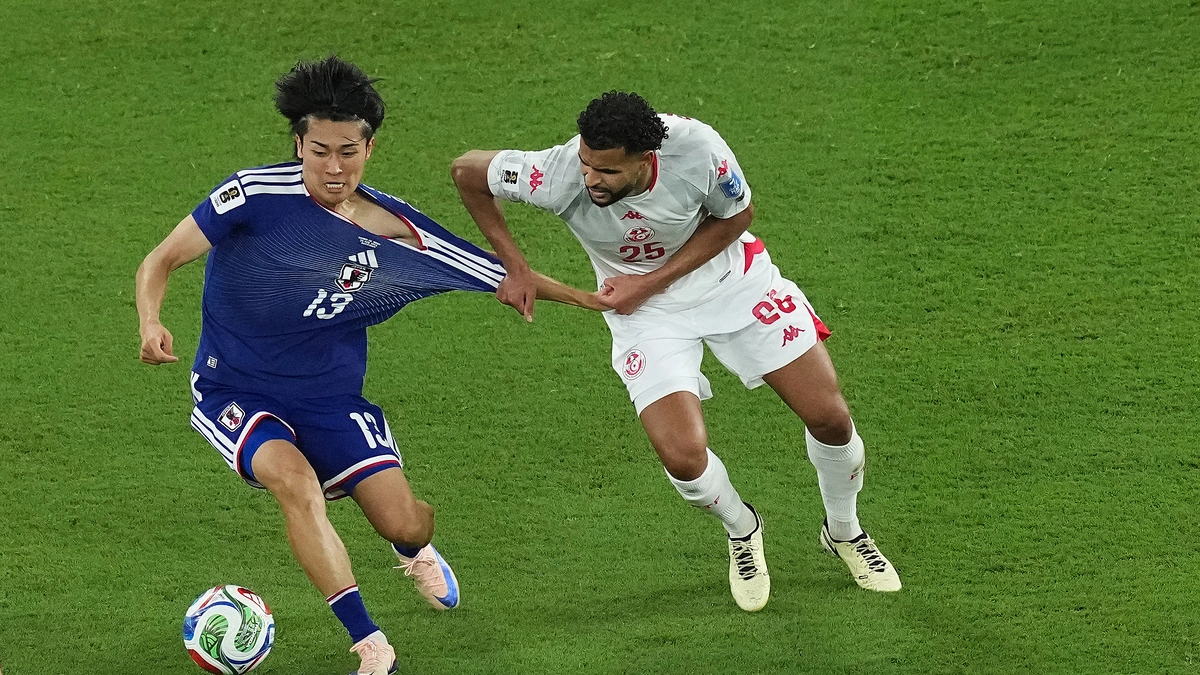
Japanese midfielder criticized for wearing socks too short
Midfielder Keito Nakamura drew attention by pulling his socks down too low during Japan's matches at the 2026 World Cup.
In the past two group stage matches, Nakamura played with socks covering only a small part of his shins. Compared to the average professional player, his socks were significantly lower, leaving most of his lower legs exposed. This image became a topic of discussion on many football shows.
Advertisement
Stay
Playback speed
1x NormalQuality
AutoBack322p240p144pAutoBack0.25x0.5x1x Normal1.5x2x
/

Tunisia's Anis Slimane pulls Keito Nakamura's shirt during the match against Japan in Group F of the 2026 World Cup in Guadalupe, near Monterrey, Mexico on June 20. Photo: AP
Nakamura, 25, plays for French Ligue 2 club Reims. He still complies with the laws of the game by wearing shinguards. According to the International Football Association Board (IFAB) regulations, players must wear shinguards of a suitable size that are covered by their socks. The rules do not specify how high the socks must be, as long as the protection is fully covered.
However, compliance with the rules does not mean approval.
Pundit Jonas Gronner of broadcaster NRK, also a former player in the Norwegian league, reacted when asked about Nakamura's style. "I hate it. This look is the worst I've ever seen," Gronner said.
According to Gronner, the issue is aesthetic rather than professional. He believes football socks should be pulled up high as traditional, instead of being loose around the ankles.

Gronner's socks were pulled high when he played in Norway in 2020. Photo: NTB
A similar view was shared by commentator Richard Keys. In a previous Sky Sports show, he criticized the growing trend of low socks among players. "This has to stop," Keys said. "They look like little boys who can't afford clothes that fit. They are professional players, so they should show professionalism."
The trend of pulling socks down is increasingly common in modern football. Many players cut their socks short or use very small shinguards to increase comfort during play.
Last year, the Norwegian Football Federation (NFF) even had to issue new guidelines regarding shinguard sizes, after many referees reported players using guards that were too small or substandard.
Jan Olav Knutsen, Chairman of the NFF's Guidelines Committee, said some referees even detected cases where players stuffed newspaper inside their socks instead of shinguards. "It is an increasingly common problem," he said.
However, many players still defend their choice. Midfielder Julius Madsen of Danish club Horsens said he switched to low socks after frequently suffering from cramps. "Since the change, I don't get cramps anymore," Madsen said. "When wearing high socks, I feel tighter. That's why I do it."
Jack Grealish in a friendly match between England and Austria at Riverside Stadium, Middlesbrough, England on June 2, 2021. Photo: Reuters
A famous player with this style is Jack Grealish. The English midfielder has played for years with his socks pulled down below his calves, creating a signature look. Grealish once shared that this habit started in his youth, when his socks kept slipping down during matches. Coincidentally, he played very well that season, so he decided to keep the style until now. However, even Grealish has not pulled his socks as low as Nakamura.
At the 2026 World Cup, many other players also use the low-sock style, but the Japanese midfielder remains the most prominent case. In pre-match team photos, his socks sometimes do not even cover the middle of his calves, creating a sharp contrast with teammates like Daichi Kamada or Ritsu Doan.
The debate surrounding Nakamura is purely aesthetic. On the pitch, the 25-year-old midfielder still contributes positively to Japan, averaging an 8.11 rating over two matches, the second highest in the team after center-back Ko Itakura (8.26).
Still, traditionalists are not ready to accept the new trend. "Socks must be pulled high and there must be proper shinguards," Gronner emphasized. "I want to start a movement to address this issue, and I'm ready to lead the way."
Former South Korean star Park Ji-sung expressed admiration witnessing rivals Japan compete at the 2026 World Cup. 29
Brazilian media wary of Japan national team
Japan has become a hot topic in Brazilian media, as both teams could meet in the round of 16 of the 2026 World Cup. 49
Why don't Japan and Netherlands national teams wear flag-colored jerseys?
Japan, the Netherlands, and Australia are among the 2026 World Cup teams with jersey colors completely different from their national flags, due to various symbolic reasons. 15
Moriyasu: 'Japan must beat Sweden by a large margin to top the group'
The Japan national team only needs a draw against Sweden in the final match of Group F to advance, but coach Hajime Moriyasu wants the players to maintain a winning mentality. 125
The story behind the white eyebrows of the Japanese player
Hiroki Ito has white patches on his eyebrows and eyelashes due to vitiligo, but it was once rumored to be the result of an accident or dyeing. 10